


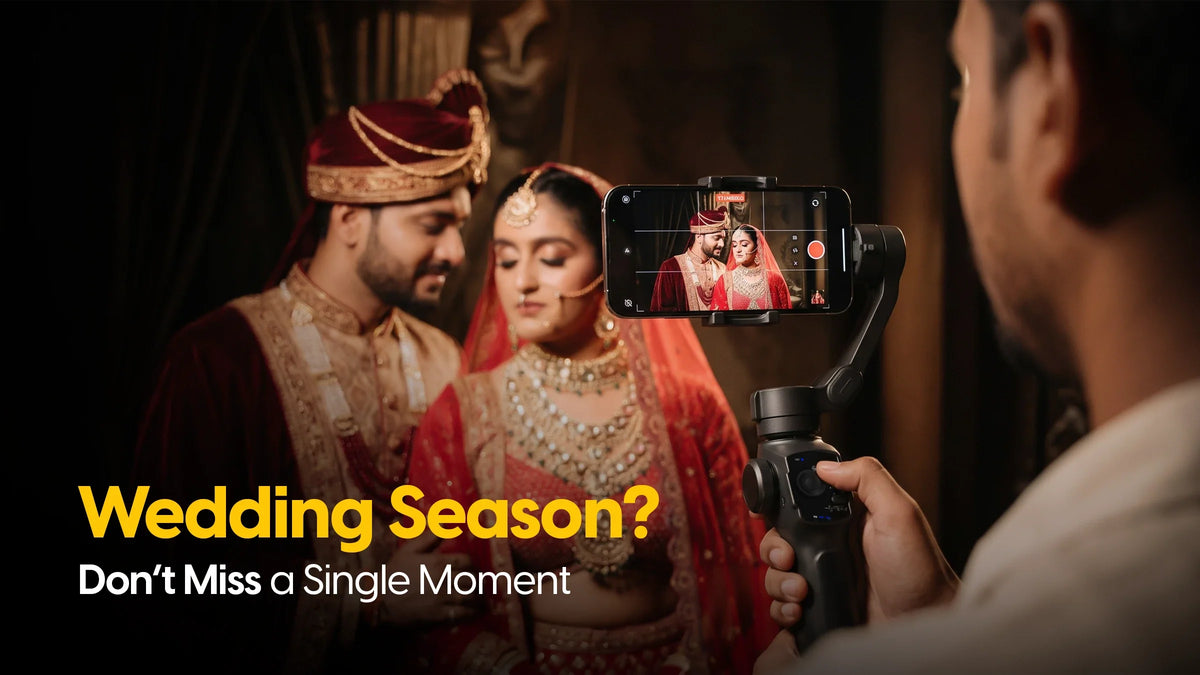
Capturing high-energy wedding moments on a smartphone isn't always easy. Moving around with your phone gives you shaky footage, blurry pics, and videos that don't quite do justice to the occasion.
That's where a gimbal for a phone can make a difference. Designed to improve smartphone stability, a gimbal helps you capture smoother footage while moving around. And if you're creating wedding reels, managing social media coverage, or recording memories for yourself, the right smartphone accessory can make filming considerably easier.
Let's explore how to choose the right setup and the Digitek products worth considering this wedding season.
Why Choose a Gimbal for Phone to Record Weddings?
Capturing videos and photographs in a wedding involves constant movement. Whether you're the bridesmaid following the bride during her entry, recording a dance performance, moving through a decorated venue, or capturing candid shots of the guests.
Holding your smartphone while trying to frame these shots can make footage shaky, especially when you're walking or changing directions.
A smartphone gimbal uses a motorized stabilization system to compensate for certain movements and keep your phone better balanced while recording.
Not only does a Gimbal give you better shots, but it makes them stable and much more professional.
For wedding content creators and social media managers, this can be particularly useful when producing short-form videos. Instead of relying only on static clips, you can capture movement, follow subjects, and experiment with different camera angles with minimal equipment.
However, a gimbal isn't the only accessory worth considering. For fixed-angle videos, group recordings, and hands-free family photos, a tripod can be a lifesaver.
Gimbal vs Tripod: Which One Should You Use for Wedding Content?
A gimbal and a tripod serve different purposes. While a gimbal helps stabilize your smartphone during movement, a tripod holds it in a fixed position for hands-free selfies and wide-angle videos.
Understanding this difference can help you choose the right equipment for different wedding functions.
|
Recording Requirement |
Smartphone Gimbal |
Mini Phone Tripod |
|
Walking and moving shots |
More suitable |
Not designed for this |
|
Following a moving subject |
Suitable, with tracking features |
Not suitable |
|
Fixed-angle recordings |
Possible, but less practical |
More suitable |
|
Group videos and selfies |
Useful for handheld framing |
Useful for hands-free framing |
|
Behind-the-scenes content |
Useful for moving footage |
Useful for stationary footage |
|
Recording alone |
AI tracking can help |
Remote control can help |
If you're creating cinematic wedding clips or following people across a venue, a smartphone gimbal is the more practical choice. If you need to position your phone and record without holding it, a mini phone tripod is a better fit.
Both accessories can complement each other, particularly for creators and social media managers handling different types of wedding content.
Best Digitek Gimbals for Recording Wedding Videos
Simply put, a good gimbal should be less bulky, easy to move around, and offer stability without hassle. Digitek offers different options, ranging from three-axis stabilization to AI-assisted tracking and compact smartphone gimbals with extensions.
Digitek DSG 007F: For Smooth Moving Wedding Shots
When you're recording a wedding, some of the best footage comes from moving with the stars of the night. Whether you're following the bride and groom, walking through the venue or capturing guests on the dance floor, the Digitek DSG 007F is designed to help make handheld smartphone footage smoother.
This 3-axis smartphone gimbal uses physical stabilization to compensate for unwanted camera movement. Its three operating modes also give you more control over how the gimbal responds while recording and let you switch between them with the press of a button.
Key features:
- Three-axis physical stabilization.
- All Follow, Half Follow, and All Lock modes.
- 160° tilt, 325° roll, and 340° pan angles.
- Landscape and portrait shooting support.
- Foldable design weighing approximately 362 g.
- Compatibility with a wide range of smartphones.
The three operating modes make it easier to adapt the gimbal to different filming situations. You can use it to follow movement, maintain a more locked camera position, or capture footage while changing your shooting direction.
During a wedding, this can be useful for recording entries or capturing dance performances from different angles. Its foldable design also makes it easier to carry between wedding functions.
Best for: Moving wedding shots and venue walkthroughs, bride and groom entry, dancing shots
Digitek DSG 007F AI: For Solo Creators and Automatic Subject Tracking
Recording wedding content alone can be challenging, especially when you need to stay in front of the camera while moving around. The Digitek DSG 007F AI solves this with an AI tracking module that can automatically follow a face or object.
You also get 4 creative option modes for the perfect shots. And the best part: if you need better angles for a stable shot, you can detach the AI tracker and get better filming versatility.
Along with three-axis stabilization, it includes a built-in fill light and gesture control, making it a useful option for upcoming social media managers and wedding content creators who frequently record themselves.
Key features:
- Three-axis stabilization.
- AI face and object tracking.
- Detachable AI tracking module.
- Built-in fill light.
- Gesture control.
- 325° roll, 160° tilt, and 340° pan angles.
- Foldable design weighing approximately 362 g.
- Up to five hours of working time as stated in the product listing.
The AI tracking feature is particularly useful when you're recording yourself without someone operating the camera. You can set up your shot and move within the tracking frame while the gimbal follows your subject.
For wedding creators, this can help with outfit transitions, behind-the-scenes videos, solo dance clips, and talking-to-camera content. The built-in fill light can also help add illumination when recording in dimmer environments.
Best for: Solo creators, moving shots with a subject.
Digitek DSG 003 ACH: For Flexible Framing and Selfie Shots
Sometimes, you need a setup that makes it easier to record yourself, capture group shots, or experiment with different framing options. The DSG 003 ACH is a compact option for selfies, group shots, and home use.
It also includes front and rear fill lights, along with a built-in tripod base. The best part is it is a great find for people who want their home functions looking perfect. Not exclusively for content but for grasping the best memories that they can.
Key features:
- Single-axis stabilization system.
- Extendable telescopic rod up to 396mm.
- Built-in front and rear fill lights.
- FPV mode.
- Integrated tripod base.
- Landscape and portable shooting modes.
- Clockwise and counter-clockwise rotation functions.
The extendable rod gives you additional flexibility when framing selfies and group videos. You can also use the tripod base when you want to position your phone for a stationary recording.
During wedding functions, this can be useful for capturing group moments, recording yourself with friends, or getting a wider perspective without having to hold your phone at arm's length.
Best for: Selfies, group shots, and flexible framing.
Best Mini Phone Tripods for Hands-Free Wedding Recording
A smartphone gimbal is useful when you're moving around, but what happens when you need to record from one fixed position? This is where your three-legged friend, a mini phone tripod, becomes useful.
Whether you're recording the bride’s makeup session, setting up a group video or capturing behind-the-scenes footage, a tripod lets you position your smartphone without holding it throughout the recording.
Here are two Digitek tripods to consider.
Digitek DTR 260 GT: For Flexible, Hands-Free Recording
The Digitek DTR 260 GT is a compact Gorilla-style tripod designed for smartphones and compatible cameras. Its flexible legs allow you to position it on suitable surfaces, while the included phone mount and remote make hands-free recording easier.
It's well balanced and crafted with high-quality ABS material, so you don’t have to worry about it falling and damaging itself or your phone. Plus, the malleable legs are great for clasping onto hooks, lights, chandeliers, anything you name.
Key features:
- Approximately 33 cm tripod height.
- Flexible Gorilla-style legs.
- Maximum load capacity of 1 kg.
- Rotating ball mechanism for angle adjustment.
- Smartphone mount.
- Bluetooth remote.
The flexible legs make it easier to position the tripod on different surfaces, while the remote lets you start recording without touching your smartphone. This can be helpful when you're setting up a fixed shot and need to be in front of the camera yourself.
For wedding content, use it to record makeup preparations, outfit transitions, group videos, or behind-the-scenes clips. It is also a convenient option for creators who want a compact tripod that can be carried between functions.
Best for: Hands-free and stationary recordings.
Digitek DTR 320 FT: For Flexible Mounting and Camera Placement
If you need a tripod that can support different recording devices and offer more flexible positioning, the Digitek DTR 320 FT is a great option to consider.
It features flexible, rubber-coated legs and a ball head that allows you to adjust the camera angle. Unlike a regular tabletop tripod, its legs can be adjusted around multiple supports or placed on uneven surfaces.
Key features:
- Flexible, rubber-coated tripod legs.
- Maximum load capacity of 3 kg.
- 360° rotating ball head.
- 90° tilt adjustment.
- Smartphone, action camera, and compatible camera support.
- Anti-slip feet.
- Carry bag included.
The flexible legs can help you find the perfect mounting position when a flat surface isn't around (perfect for open weddings). Its ball head also lets you adjust the framing between landscape and portrait orientations.
For wedding creators, this is great for setting up fixed-angle recordings, capturing venue details or positioning a camera in compact spaces. Its higher load capacity also makes it suitable for compatible cameras, provided the complete setup stays within the stated limit.
Best for: Flexible mounting and fixed-angle shots.
How to Choose the Right Smartphone Gimbal or Tripod for Your Needs
Depending on what you're planning to film at your weddings, you will need a different type of gimbals/tripods. If you're filming while following the couple around, versus filming outfit changes or static content for socials, you'll need something different.
Here are a few points to think about:
1. Do you film whilst moving?
If you're filming a lot while walking around, trailing people or moving between spots, then you may want to invest in a 3-axis smartphone gimbal. This will help eliminate any unwanted shake and produce smooth footage.
2. Do you create content alone?
If you’re your own cameraman most of the time, consider a gimbal with AI tracking or a tripod with a remote. This can help you film easily without having to ask someone to hold your phone for you.
3. Do you need automatic subject tracking?
Using an AI gimbal will help ensure you can keep your moving subject in shot. This is perfect if you're filming solo, such as dance clips, outfit changes and other moving content
4. Do you mostly record fixed-angle videos?
If you're filming static content, then a mini phone tripod would be the best option. This means you can set your phone up to film group videos, makeup or behind-the-scenes content.
5. Do you need flexible mounting options?
If you often travel to exotic or different locations, a flexible tripod can help you position your phone on suitable uneven surfaces or around most available supports. Always check the mounting position and load capacity before setting it up.
Digitek Smartphone Gimbals and Tripods Compared
If you're still deciding which accessory suits your recording style, here's a quick comparison of the five options.
|
Product |
Unique Features |
Price |
Best For |
|
DSG 007F |
3-axis stabilisation, 3 operating modes |
Rs 4,999 |
Smooth moving shots |
|
DSG 007F AI |
AI tracking, fill light, gesture control |
Rs 5,999 |
Solo content creation |
|
DSG 003 ACH |
Telescopic rod, front and rear fill lights |
Rs 2,999 |
Selfies and group framing |
|
DTR 260 GT |
Flexible legs, remote, 1kg load capacity |
Rs 399 |
Hands-free recording |
|
DTR 320 FT |
Flexible legs, 360° ball head, 3kg load capacity |
Rs 699 |
Flexible camera placement |
Our Verdict: Which Digitek Gimbal or Tripod Should You Choose?
It all boils down to what kind of wedding videos you want to produce.
If you tend to roam around a lot, shooting various wedding functions, the Digitek DSG 007F will suit your purposes quite well. For a creator who works alone and wants his camera to track the subject automatically, the DSG 007F AI will help a bit more.
For those who like to work with a smaller configuration using an extension rod, the DSG 003 ACH is another option. If you only shoot simple videos hands-free, then the DTR 260 GT can be a good choice for you. The DTR 320 FT is a good choice in case you want to position your compatible camera/smartphone freely.
You do not have to use the same accessories all the time. Just consider what shots you usually record, how much movement you need to do, and whether you are going to control the smartphone or not. This way, picking up the right setup will become much simpler.
Frequently Asked Questions
1. Is a gimbal for phone useful for recording wedding videos?
Yes. A gimbal for phone helps reduce unwanted camera movement while recording, making it useful for wedding entries, dance performances, venue walkthroughs and other moving shots.
2. Can a smartphone gimbal make videos look smoother?
Yes. A smartphone gimbal uses stabilisation to compensate for certain movements, helping reduce camera shake during handheld recording.
3. Does a 3-axis gimbal offer more stabilisation than a single-axis model?
Yes. A 3-axis gimbal compensates for movement across three axes, while a single-axis model offers more limited stabilisation.
4. Can a smartphone gimbal automatically track a moving person?
Yes, if it has an AI tracking feature. The Digitek DSG 007F AI can track faces and objects using its detachable AI tracking module.
5. Can you build a good wedding filming setup within Rs 6,000?
Yes. You can put together a practical gimbal and tripod setup for under ₹6,000 with the right Digitek accessories, making it easier to capture wedding moments without investing in expensive equipment.
6. Is a mini phone tripod useful for recording wedding content?
Yes. A mini phone tripod helps position your smartphone for hands-free recordings, group videos, outfit transitions and fixed-angle wedding content.
7. Can a tripod phone holder replace a smartphone gimbal?
No. A tripod phone holder supports stationary recording, while a gimbal is designed to stabilise your phone during movement. They serve different filming requirements.
8. Can you record wedding videos alone using a Digitek gimbal?
Yes. The DSG 007F AI offers automatic subject tracking, while other models can help with handheld recording and flexible framing.
9. Can a flexible mini tripod be used on uneven surfaces?
Yes. Models such as the Digitek DTR 260 GT and DTR 320 FT have flexible legs that can be positioned on suitable uneven surfaces or supports.
10. Is a smartphone gimbal suitable for recording dance performances?
Yes. A smartphone gimbal can help capture smoother footage while following performers, although your movement, framing and shooting position still matter.
Capture More Wedding Moments with Digitek
From smooth moving shots to hands-free recordings, the right smartphone accessory can make creating wedding content easier. Explore Digitek's range of smartphone gimbals and flexible tripods to find a setup that suits the way you record, create and share every celebration.
Get your Digitek accessories now and capture every moment in a better way!

Leave a comment
This site is protected by hCaptcha and the hCaptcha Privacy Policy and Terms of Service apply.